









Starting Strong Online: Expectations, Structure, and Best Practices

By Tim Whiting
In her book Small Teaching Online: Applying Learning Science in Online Classes, Flower Darby paints a picture of the first day of class at a university. She has created such a descriptive account that I cannot give it justice, so I will sum it up in five points (in all actuality, you should just read her book).
-
It’s your first day of class on your college campus.
-
You can’t find the classroom.
-
When you do, no one is there.
-
You find a syllabus and thumb through it.
-
You are disappointed.
(Seriously, read the book.) For those who had a “traditional” college experience, it appears far-fetched. Now, consider the same scenario but in an online course. Unfortunately, that is all too real. The online learning experience can be one of convenience yet confusion. One of exploration yet frustration. One of success or one of failure.
How can you, the instructor of online learning, guide your students to be successful and not feel this frustration? Often, it is assumed that if an instructor has taught face-to-face classes, they can easily slide into the online environment. Although there is some truth that “good teaching is good teaching,” strategies and mindsets do not always translate.
In this article, we will take the approach starting with the very basics of online learning and applying your institution’s expectations with some basic best practices. In future articles, we will expand on instructional strategies and the use of technology.
Why online classes?
In the 2024 edition of the Online College Students Report by Education Dynamics, there are three reasons that students are attracted to online courses: flexibility, affordability, and speed to completion (Aslanian et al., 2024). Alexandria Walton Radford of RTI International stated that about a third of online learners have two or three of the following challenges: they have delayed enrollment, they have a child or other dependent, they’re enrolled in school part-time, they work full-time, or they are a single caregiver (Darby & M, 2019). On the flip side, a March 2025 article from the Hechinger Report states that universities have moved to offering online learning opportunities due to demand from students, with 54% of students taking at least one online course in fall 2022 (Marcus & Marcus, 2025). Being aware of the motivations of students taking online courses helps you, the instructor, to know how to address student needs.
What makes a good online student
In a 2015 article, Heather Kauffman identifies the following characteristics as ones evident in students who succeed in asynchronous online courses: students who are good at organizing, good at planning, good at managing their time, disciplined, aware of the need to seek help when appropriate, and resilient (Kauffman, 2015). If you have been a college student, taught a college student, or been a parent of a college student, you might argue that those are characteristics of students that are successful in a face-to-face course as well. As an online instructor, you do not get to choose the students in your course. Therefore, detailed and intentional planning, organization, communication, and implementation by the instructor aid the student in their success.
Expectations, Processes, and Procedures
Online courses must follow guidelines that are consistent with accreditation requirements through such organizations as SACSCOC and The Higher Learning Commission. These organizations establish definitions, requirements, and expectations for distance education. The first step in creating your online course is knowing these expectations. You will need an understanding of your institution’s expectations in the following areas.
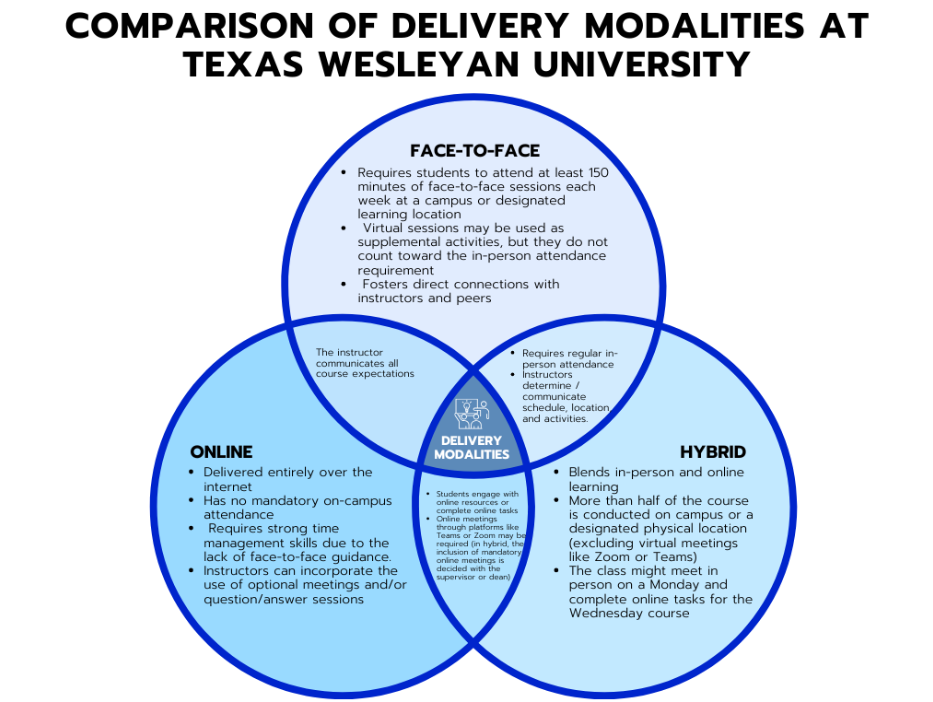
Delivery Modality: Understanding the differences between hybrid, online, and face-to-face course formats is essential, as each has distinct features that shape the learning experience. The basic difference between the three is the about of time that you, as an instructor, can physically reach out and touch your students.
Face-to-face=every class
Hybrid=half of the classes
Online=never.
Now, for a clearer explanation, consider the following graphic:
Credit Hours: No matter the mode of instruction, there are requirements that are set regarding time spent on a class. A credit hour represents the amount of work intended to meet learning outcomes. With most accreditation standards, one credit hour requires a student to spend at least one hour of “classroom or direct faculty instruction and a minimum of two hours out of class student work each week for approximately fifteen weeks for one semester.” Have a clear understanding of the time requirements as it varies based on the number of weeks in a term. Keep one important aspect in mind: an instructor cannot just decrease assignments during a 7-week course. The rigor and time requirement must remain the same.
Rigor: No matter the modality, whether it is face-to-face or online, courses that are at the same level must maintain the same level of rigor. Keep in mind that postgraduate and graduate level programs require a higher degree of rigor, including skills to support independent research and professional practice.
Technology: Know the technology capabilities and requirements of your institution. Also, know the expectations. Students enrolled in online classes should have the ability to log on and have access, but if you expect additional technology use, you will need to ensure that it is in line with the expectations of the institution and the course.
Training: Accreditation requires instructors of online courses complete training on teaching online courses. This varies by institution. At Texas Wesleyan University, contact CETL to learn about training requirements and options.
Additional requirements: There are a variety of requirements that vary based on institution. Here are examples of such requirements. Reach out to your institution for specifics on each.
-
Establishment and follow through on learning objectives and outcomes.
-
Complete of a specific number of activities (often based on rigor)
-
Level of interaction. This includes student-instructor as well as student-student.
-
Quality of feedback
-
Timeliness and quality of responses, communication, and feedback.
-
Meeting accessibility requirements established through the Americans with Disabilities Act (ADA).
Best Practices at TXWES
The online learning environment presents a unique set of challenges that require a clear definition of instructor performance. The following best practices identify the minimum level of interaction and management needed between students and instructors to maintain a quality online learning environment. Consider these “best practices.”
-
Follow the established course start and end dates. Don’t forget to include established breaks in the schedule.
-
Establish and maintain a detailed yet engaging syllabus. A syllabus establishes the guidelines, expectations, and pacing for your course.
-
Follow consistent guidelines for managing your online course. Identify tasks that should be performed daily, weekly, or by semester. The key to effectively managing an online course is being consistently "present" in your online classroom. Regular contact with your students helps assure them that they are well-supported. The online classroom can become even more "personal" than the face-to-face one. Through regular communications with your students, observations of their discussions in discussion forums, reading notes they share publicly with one another, and so on, you will be able to connect with your students and learn about them as individuals.
-
Monitor assignment submissions and communicate with students to remind them of missed and upcoming deadlines. Practicing proactive course management strategies can help ensure a successful learning experience.
-
Establish a regular schedule for when you will be logging in to the course and communicate this to students. Online students tend to be more active in courses on weekends, so reserve time in your schedule to monitor courses at least once on weekends. If you set up a due date of Sunday at 11:59 pm, expect to be responding to questions on Sunday.
-
Provide responses and feedback to student inquiries within one weekday. Be accessible! Because online learners must manage their time carefully, timely instructor feedback and responses to questions is critical. Real-time communication can be particularly valuable if a student seems upset or anxious.
-
Utilize assignment rubrics so students know how you will grade their work and what they need to do to earn the best possible score. This means that your grading will be fair and consistent.
-
Provide meaningful feedback on student work using clear and concise language. You have ideal "teachable moments" when providing feedback on student work. Simply telling a student "good job" or "needs work" does not give them the information they need to succeed. They need and want more specifics. What was it that made the work good so they could repeat it? What needs more work, and how can they improve the quality of their work?
-
Communicate to your students when you will grade and return all assignments and exams. Online students need to self-regulate their time and learning and will need to adapt as needed.
-
Make sure you have immediate and predictable access to the same technology that is required for students in your course.
-
Submit needed documentation and post grades at required times. This may include the attendance census, procedures for dropping students, posting midterm grades, entering final course grades, and the end-of-course survey information.
-
Consider allowing students to see all future week's content. Remember that online students are very busy and choose the online modality to accommodate their lifestyle.
-
Encourage your students to complete your end-of-course survey. Not only are end-of-course surveys accreditation and institution requirements, they help you develop your craft. The most decisive influence on whether a student completes an end-of-course survey is you, the instructor.
-
Contribute to the continual update and improvement of your course content. As in a face-to-face course, an online instructor is expected to keep the content of the online course current. As you update your course content, learning activities, and assessments, pay attention to spelling and grammar, copyright, usability, and accessibility to ensure compliance with legal requirements and institutional policy.
In Conclusion...
An online class can be impersonal and intimidating, or it can be engaging and welcoming. By being intentional in organizing your course and creating practices and systems, you can create an environment in which students feel supported and successful. It starts with “the first day of school,” but must remain consistent throughout the life of the course.
References
Aslanian, C. B., Fischer, S., Aslanian Market Research, EducationDynamics, EducationDynamics, Bruce Douglas, Greg Clayton, Tracy Kreikemeier, Katie Tomlinson, McKenna Serpa, Eric McGee, Nancy Kim, Rick Kitchell, Dr. Lisa Braverman PhD, & Sara Weaver. (2024). 13th Annual Report on the Demands and Preferences of Online College Students. https://insights.educationdynamics.com/rs/183-YME-928/images/EDDY-Online-College-Students-2024.pdf
Darby, F., & M, L. J. (2019). Small teaching online: Applying learning science in online classes. https://eduq.info/xmlui/handle/11515/37834
Kauffman, H. (2015). A review of predictive factors of student success in and satisfaction with online learning. Research in Learning Technology, 23. https://doi.org/10.3402/rlt.v23.26507
Marcus, J., & Marcus, J. (2025, July 14). Most college students are taking online classes, but they’re paying just as much as in-person students. The Hechinger Report. https://hechingerreport.org/as-online-higher-education-hits-a-milestone-why-does-it-still-cost-so-much/