




From the Shore to the Deep End: Using Service-Learning in College Courses

By Tim Whiting
Like most children, I was shoved into swimming lessons at an early age. I learned really quickly that I would rather stand in the wading pool or hang onto the side rather than swim in the deep end. Then, my family moved to a farm with a pond. My dad and older brother would take the canoe to the middle and jump in. I was determined to continue with my current practice and stand by the shore. What I found out was that it meant standing in the mud. Mud in which leeches lived. I figured out really quickly how to jump into the deep end and swim in a pond.
We don’t learn to swim by standing in the wading pool. The same can be said when our students start their careers. They need to learn how to work with others and effectively utilize the skills that they have been taught. What better way than through service-learning opportunities? Internships are great opportunities for students to learn the practices of their craft, but what can we, as instructors in higher education, do to give students opportunities within our courses? Service learning provides students with those opportunities.
The purpose of this article is to provide guidance to you, the college instructor, in utilizing service learning within your courses.
Start With a Definition
Dwala Chandler, Director of Service Learning at Texas Wesleyan University, (personal communication, December 15, 2025) defines service learning as “an innovative teaching and engagement strategy that allows faculty and staff to integrate meaningful community service with instruction, reflection, and support.” The American Association of College and Universities (AAC&U) calls service learning a high-impact practice, “based on evidence of significant educational benefits for students who participate in them—including and especially those from demographic groups historically underserved by higher education” (AAC&U, 2023). Yes, it is an interactive approach to learning, but it can be more. It takes a hands-on approach and creates impact in the community. Chandler further iterates that “this approach fosters a deeper understanding of course content, strengthens campus-community connections, and addresses real-world challenges.” Think of it as an internship with meaning. Students can learn real skills as they make a positive impact on their community and their world. It can be as small or as big as you want to make it.
Think About the “Why”
The benefits of service learning are multifaceted. It reaches the students, the faculty, the university, and the community as a whole.
For the students, service learning enhances their learning experience, both in the specific course and overall. They are able to take the content and the ideas that they are learning and apply it as a skill. It is one thing to review PowerPoints on tax law and complete simulated scenarios with pretend clients, but it is a completely different experience to sit down with actual clients to provide free tax assistance, helping them prepare their yearly tax forms. They are applying the skills that they learn in class. They can take these experiences and add them to their resume, showcasing their skills and talents.
GivePulse.com breaks it down further, explaining that, through service-learning, students:
- Deepen their understanding of their relationship to their communities
- Translate what they're learning into action, developing problem-solving skills
- Build workplace skills, from fundraising and data analysis to interpersonal and communication skills
- Learn more about their purpose and the impact they wish to have on the world
- Develop cultural competence and empathy
(G. Team, 2023)
For the faculty, incorporating service-learning experiences into their courses enriches their teaching. It adds another element. They have the research and knowledge but, that research and knowledge is little without action. What is the most common question asked? “When am I going to use this?” Now more than ever, universities and higher education have to provide the answer. By bringing in service learning, the instructor is demonstrating how, when, and why the “what” is used. The faculty can also use the service-learning opportunity to connect to their research and their own professional goals. It gives the faculty as well as their institution a connection to the community. They will benefit with this community connection as they build their courses, their programs, and the reputation of the institution.
The larger stakeholders include the university and the community as a whole. Encouraging students and faculty to participate in service learning impacts the culture of the university as participants are working together for a common cause. For the community, they have local needs addressed. This leads to partnerships being formed between local organizations, local government, the university, and the members of the community as a whole. Connections are formed and, as they say, there is strength in numbers.
Service-Learning at TXWES
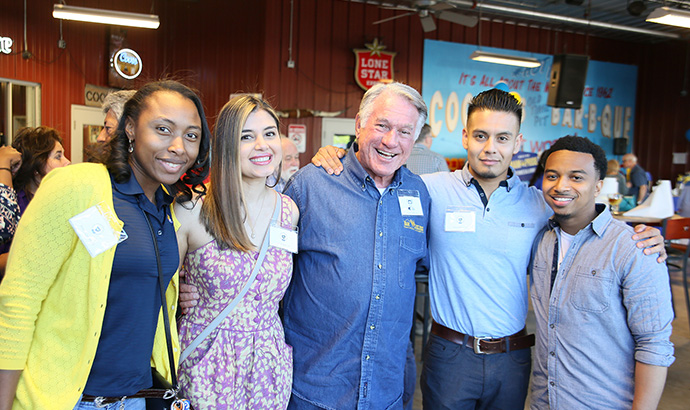
At Texas Wesleyan University, there are a number of opportunities for service-learning that students and faculty have participated in within the last year.
- Students and faculty sorted, inspected, and repackaged donated food products to be distributed to partner organizations across a 13-county area at the Tarrant Area Food Bank.
- Faculty, staff, and students worked together to package more than 500 meals for older adults through Meals on Wheels.
- TXWES Accounting students assist community members with preparing and filing their taxes during tax season.
- Students collaborated with Cornerstone Assistance Network to support and analyze their re-entry program data using GIS mapping and analysis tools.
- Students partnered with Poly Main Street to support revitalization efforts and promote economic development in the Polytechnic Heights community.
Community organizations that Texas Wesleyan University has connected with include:
- Hope-4-Kids
- Various school districts
Student Testimonial
Don’t take my word for it. Ka Ryan Williams (Class of ‘24 General Business), participated in the Volunteer Income Tax Assistance (VITA) program and as a student leader with the Poly Main Street Initiative and she had plenty to say about her experiences participating in service learning opportunities.
- “Through this program (VITA), I gained extensive knowledge in a short period of time, earned multiple certifications, and completed over 60 volunteer hours.”
- “VITA also allowed me to build valuable relationships, expand my professional network, and truly see the importance of using my skills to serve the community while continuing to learn and grow.”
- Through the Poly Main Street Initiative, “I had the opportunity to communicate directly with community members, board officials, stakeholders, and individuals working with the City of Fort Worth.”
- “This experience (The Poly Main Street Initiative) provided me with a hands-on community engagement experience and helped me better understand the needs of the community.”
- “I believe that participating in these service-learning opportunities benefits students such as myself by allowing us to gain meaningful, real-world experience beyond the classroom.”
- “All of these skills and experiences have helped prepare me for my future career and will continue to be useful as I move forward professionally.”
-Ka Ryan Williams
Questions To Ponder
Okay... so you are convinced. It is time to bring in a service-learning opportunity into your course. What’s next? Well, first of all... think. It is time to think about what it may look like in your course. Consider answering the following questions as you plan it.
How does service learning connect to this course? You may have bought in but do the students? They will want to know why they will be required to participate in a service-learning opportunity in this course. What is the connection? Some courses may be easier to connect to an experience. For example, participating in after school tutoring programs makes sense in an education course. What connection is there in a freshmen level history course? A psychology course? To answer this for your course, start with the course objectives and program goals. Think about the fields that those with the degree enter into. Bounce ideas off colleagues and get the opinions of others in your field.
What are the benefits of service learning (both short-term and long-term) for the students in this course? Take your answer to the previous question and create concrete examples. How will they benefit from the experience immediately, and how will it connect to their future career goals? This may be a connection that you guide students into making for themselves. As you continue service learning over a couple of semesters, gather student input and testimonials that you can provide your new students with.
It is ok to start small. You do not have to start with a semester long experience the first time that you incorporate service learning. Think of an experience that is easy for you to incorporate. Maybe it is an event or organization that the university has already established. Maybe you start with a smaller number of required hours for students so that you can get a hold of the logistics.
What are the expectations for students? Think about the following:
- How many hours will be required and by when?
- How will they record and submit their hours?
- How will the hours be verified?
- Will they have choice in what opportunities to participate in, or will they have to participate in a certain event or activity?
- Who will provide service-learning opportunities? Will it be the instructor or will students have to find their own?
- Will the hours be outside of the class period or will there be some opportunities during class?
If your institution has established service-learning within courses, consider visiting with other instructors, your supervisor, or service-learning leadership to understand what expectations have been established previously. Doing so will provide uniformity and effective buy-in.
How does service-learning tie into grading and course work? In most cases, the service-learning opportunity will be one of enrichment. With that in mind, think about how you will assess the student’s experience. If you are requiring students to complete a certain number of hours, a simple point scale will suffice, but keep in mind the learning process. The overall experience can be tied up in a reflection activity. Utilizing a discussion board for reflection allows other students to learn from each other’s experiences. Consider allowing students to have choice in how they will present their reflection. These methods could be written, recorded (audio or video), or presented graphically and artistically.
What are the obstacles, and how can they be addressed? Think about obstacles for the students, such as time, transportation, cost (if any), and if any specific skills are required. On the side of the instructor, consider what preparation is needed. Will you need to connect with a community partner? Will you need to be present at the activity? Will transportation be provided? Are there forms or permissions needed from either your institution or the community partner? Knowing these obstacles in advance and addressing them early will lead to a smoother experience.
Who do you need to partner with to set up the service-learning experience? Is there someone else within the university that is planning an event? Is there a specific community organization that you need to connect with? Are there campus organizations that could be of assistance?
How will everything be communicated? The first option is the syllabus. Establish expectations from the beginning. Including a well-laid out document that has expectations, requirements, and opportunities provides another avenue for students to understand the overall concept. Ensure that you have discussions and reminders for students so that they remember what is expected of them. Providing “shout outs” to students, both in class and through announcements, can encourage other students to follow through.
(Baylor University-Service Learning, n.d.)
What It All Comes Down To
Dr. Christopher Ohan, Associate Professor of History, wraps it all up.
“In my view, the specific service-learning activity matters less than the fact that my students and I are tackling it as a team. Whether we are volunteering at TAFB, Meals-on-Wheels, or Hope-4-Kids, that shared experience transforms our classroom engagement. Once we've worked together outside the classroom, students feel more comfortable opening up to me and to each other. This improved communication naturally leads to a significant boost in student learning.”
(personal communication, January 6, 2026)
A Helping Hand
You do not need to do this alone. Texas Wesleyan University has resources for you.
For information about service learning, how to incorporate it in your course, and resources, contact:
Dwala Chandler, Director for Service Learning
PUMC 304 (817)531-4915
For information on how to set this module up in your course, and how to teach service learning within your course, contact:
Center for Excellence in Teaching and Learning (CETL)
AMB 202
References
The American Association of Colleges & Universities (AAC&U). (2023). High-impact practices. AAC&U. https://www.aacu.org/trending-topics/high-impact
Baylor University-Service Learning. (n.d.). Baylor University-Academy for Teaching and Learning. Retrieved January 5, 2026, from https://atl.web.baylor.edu/teaching-guides/teaching-techniques/service-learning
Team, G. (2023, January 10). Service-Learning in Higher Education: Why it Matters. GivePulse. https://learn.givepulse.com/blog/service-learning-in-higher-education-why-it-matters